The Augustinian Order was formed by Pope Pius IV (1244). There existed in the Tuscan Hills, along pilgrim routes to such places as Rome and Loreto, small communities of what were known as hermits. These communities would each have about a dozen members, following the rule of St Augustine. Within a few years they had reached out beyond Italy, some setting up communities in France, and it was there that they met Richard de Clare, one of the wealthiest and most cosmopolitan of the Norman earls (with lands in France, England and Ireland). He invited them to come to his lands in Clare, Suffolk. Why? Perhaps he was prompted by his acquaintance with Cardinal Annibaldi, protector and promoter of the friars, or by King Henry III, an ardent supporter of the friars, be they Franciscan, Dominican or Augustinian. To arrive in Clare in 1248 they had to have been directed there. They started building immediately in the shadow of a great Norman castle.
Clare Priory became the mother house of 34 Augustinian houses in England. The number of friars swelled rapidly, and four houses of studies were founded by 1300. Through the de Clare family links they had by then also established houses in Ireland.
Unlike monks, who usually take a vow binding them to stay within their monastery, friars are expected, when ordered by their superior, to move from friary to friary over time. The popes gave friars the right to beg for their sustenance, and each friary had its own territory or ‘limit’. As such, the black-habited Augustinians were well known throughout the area from Clare to Hatfield, Chelmsford and Mersea. Some 300 towns and villages in Suffolk and Essex were regularly visited. In 1296, when Edward I visited Clare Priory, it had 29 friars. The king’s daughter Joan of Acre (not to be confused with Joan of Arc) resided in Clare Castle where, for example, two friars sang Mass daily, and members of the family were buried close to the high altar in the priory church.
The friars worshipped, prayed, studied scripture and engaged in teaching and preaching for up to two hours, and were expected to be entertaining. They spoke in English (not Latin as in the monasteries) and were popular with the common people. They kept the vow of poverty, had no personal possessions, and lived on others’ goodwill, as they still do. They helped the destitute and tended the sick. They provided hospitality to travellers, especially those on pilgrimage to major sites like Walsingham or Canterbury. They thrived, and the priory was rebuilt and expanded just before the Black Death wiped out half the population in the late 1340s. Thereafter the number of friars and priories went into decline. By the time that Henry VIII suppressed all religious houses between 1536 and 1540, there were only 15 friars at Clare.
The last prior accepted a position as a canon of Norwich Cathedral. Some friars accepted the Reformation, and others lived on as parish priests or on small state pensions. Richard Ingworth, the King’s agent, took possession of all the priory lands and buildings, and arranged for their sale to the King’s trumpeter, no less, a man called Richard Frende. The church and many buildings were pulled down, and the materials recycled in new builds around the town and to turn the Prior’s house into a grand manor house. Until recently, the old Post Office still had beams from the church. In 1596 the land was acquired by the Barnardistons from Kedington (near Haverhill) and passed through a female line to the Barker family. Lady Mary Barker, who died in 1940, urged her daughters to find the friars and hand the priory back to them. They did so, and the friars returned in 1953.
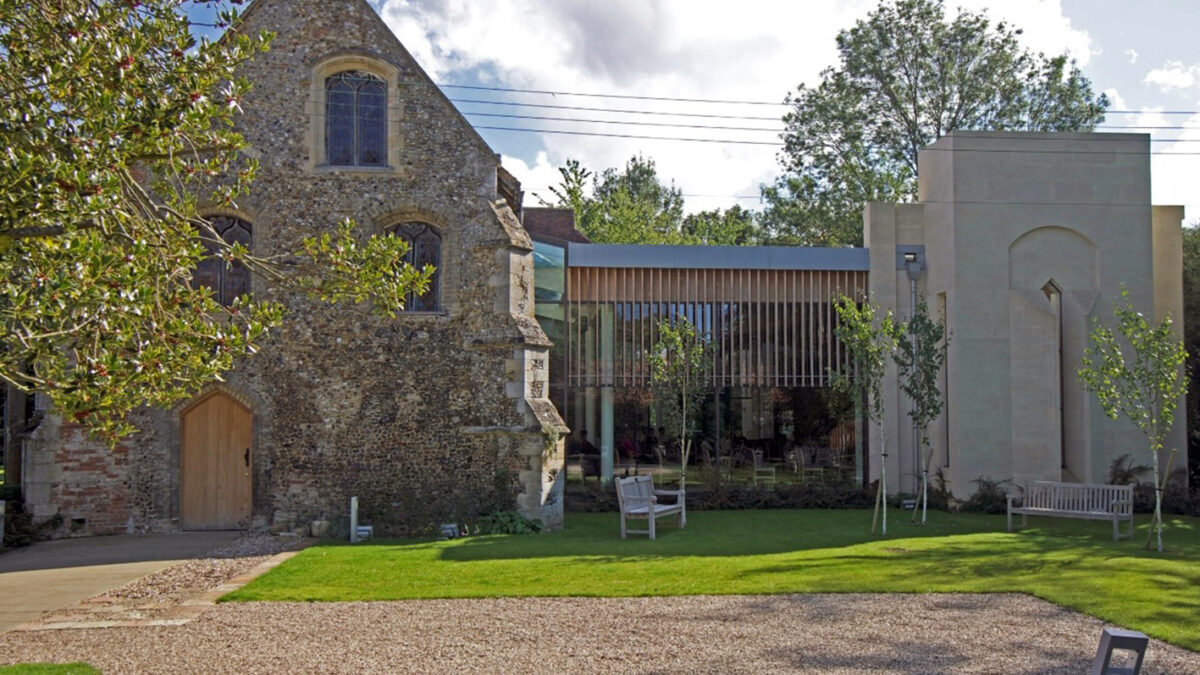
Clare has changed a lot since 1953. The smallest market town in Suffolk has become less of a centre of local crafts and trades and more the home to commuters and retirees. The train line was a victim of the Beeching cuts of the later 1960s, Clare one of 2,673 stations to close. It is a quiet, peaceful place. From 1953 onwards, the priory was used first as a house of studies, then as a novitiate until specialist facilities in Ireland took over. But as a place of peace and quiet, it soon developed as a retreat house for people from the diocese and beyond. As well as providing modern en-suite accommodation, where the old stables and garage once stood (the block opened in 1998), the Grade I listed house is ideal for small and quite large gatherings, for those staying or coming for Quiet Days, and food can be provided. Attempts to build a new church were thwarted for many years by English Heritage’s dislike of every proposed change in such a historic site. Finally, an award-winning design was accepted, and the new church was built into and out of the medieval infirmary and was dedicated in 2013. It now fits, but only just on major feasts, all who want Mass.
Since the late 1960s, the priory has taken on its present use as a house of quiet retreat, a place of prayer and meditation, a place to find peace and sort out personal problems alone or with the help of a member of the community; alternatively, one can participate in lively but intense retreat weekends with the younger Church. A warm welcome awaits all who visit. The church, extensive gardens, benches, medieval ruins, orchards and walks give ample space and facilities to enjoy the peace in the fresh air, while Clare Country Park and the town are just across the footbridge. Some people come for a day, others for several days or more, and depending on whether their stay is quiet or even silent, they mix in with the community for meals and prayer time in the main house with its medieval and later features. Many friars visit. One visitor who came in his role as Prior General or Superior of the worldwide family of the Austin, or Augustinian, friars was Fr Bob Prevost OSA, whom we now call Pope Leo XIV. He came twice and stayed in the stable house. Will he visit again? Will you come in his footsteps?