
Volunteers Needed for School Admission Appeals
December 4, 2025
St Edmund’s Parish Celebrates Feast of Its Patron Saint
December 8, 2025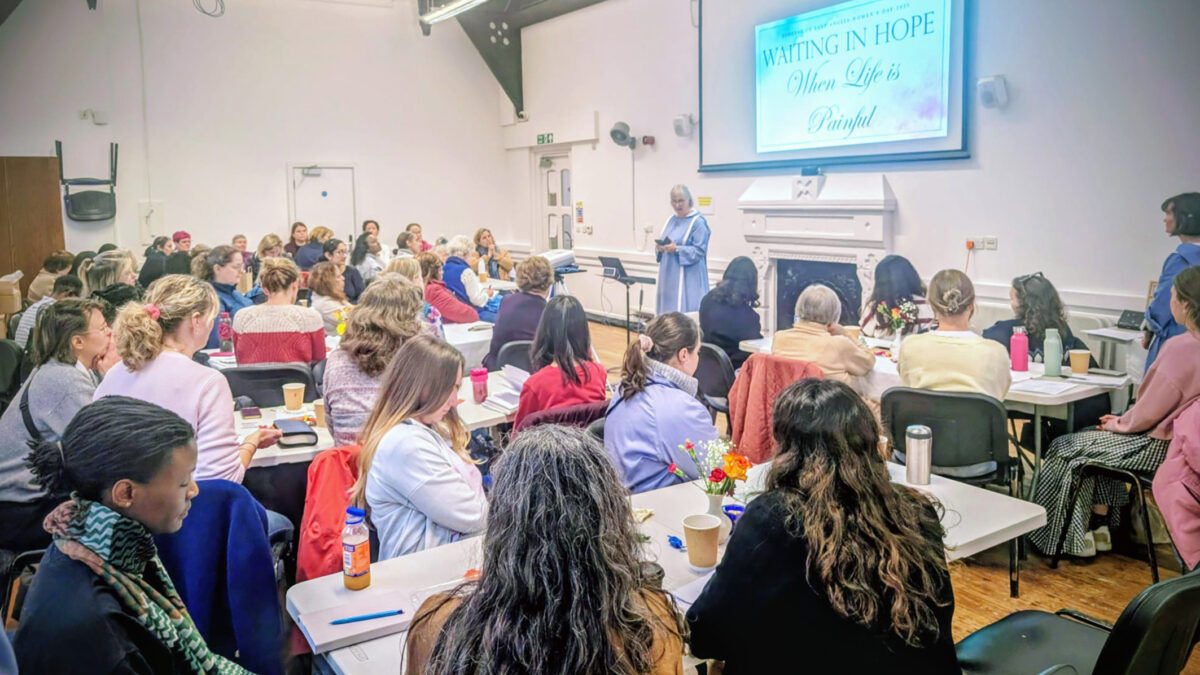
This year, the Diocese’s annual Retreat Day for Women was held at OLEM in Cambridge. Sixty women gathered to reflect on the theological virtue of hope, and in particular on “waiting in hope,” especially in times of pain and difficulty.
Through talks given by the sisters from the Community of Our Lady of Walsingham, the women were guided into a deeper understanding of what hope truly is and what it is not.
Sister Catherine began by explaining that hope is not “wishful thinking,” but a confident expectation rooted in God. As St Thomas Aquinas teaches, every virtue stands between two opposing vices, the via media or “middle way.” The virtue of hope lies between the vices of presumption and despair.
Presumption is an excess of hope, in which someone assumes they will be saved regardless of their sins or the life they have lived. Despair, by contrast, is a deficiency of hope, in which a person refuses to believe that God can forgive them or thinks salvation is impossible.
To live the virtue of hope rightly, we must know what we are hoping for. Otherwise, we may place our hope in the wrong things. God has planted in every human heart a longing for true happiness, happiness ultimately found in eternal life with Him. The virtue of hope responds to this deep yearning for joy. It inspires our actions, purifies our intentions, and directs everything we do towards the Kingdom of Heaven. Hope strengthens us in times of trial and opens our hearts to a confident expectation of spending eternity with God (CCC 1818).
However, to desire what God desires for us, we must walk along the path of holiness. “Holiness is wholeness,” Sister Catherine continued. Christ came to redeem and sanctify every part of who we are, our thoughts, emotions, memory and soul. Holiness is the journey towards this full integration. Our emotions, even the difficult ones such as anger, pain, frustration, worry, hurt and jealousy, are part of being human. They are not to be repressed or denied, but brought honestly before God so that He can heal us and make us fully alive. “I have come that they may have life, and have it to the full” (John 10:10).
This path requires letting go of control and gaining the self-knowledge to recognise the areas where we resist God. Our struggles and moments of difficulty are often the very places where He wants to meet us and lead us to freedom from what keeps us from Him and from our own wholeness. God longs for hearts willing to receive His love.
Sister Camilla then reflected on the challenge of maintaining hope when life is painful. Christian hope does not deny suffering, it transcends it. Even when we are tempted to think, “Why me? What have I done to deserve this? How much longer?” God is still at work in our lives.
The suffering and death of Jesus show us that hope is not the absence of pain but the ability to endure it with God’s faithfulness. We should not try to explain our suffering, as much of it cannot yet be explained. All will be revealed in eternity. Christ did not come to explain the cross but to show us how to carry it. “My thoughts are not your thoughts; my ways are not your ways…” (Isiah 55:8-9). Sister Camilla encouraged the women to anchor their hearts in the truth that the invisible realities are more real than the visible.
In times of trial, the right questions are not “Why me?” but rather, “What does God desire of me in this situation?” and “What conversion is being asked of me?” The sufferings God allows are often meant to purify our ego and free us to live a life closer to Him.
To see as God sees and think as God thinks we need a conversion of heart, which cannot take place without a regular life of prayer and frequent Confession. Sister Camilla recommended monthly confession. We must build our lives on the Word of God and cultivate a living relationship with Christ, because we cannot carry our crosses fruitfully without these supports. Fear of suffering can harden us into a self-protective stance, leading to irrational choices with painful consequences. But the Holy Spirit can teach us to see the cross not as a threat, but as a gift.
Brother Lawrence, a Carmelite lay brother of the 1600s, wrote the spiritual classic The Practice of the Presence of God. In it, he teaches us to recognise God’s presence in every moment of our lives and to understand how each moment prepares us for “an eternal weight of glory beyond all compare.”
Sister Camilla concluded the day by reflecting that even the ageing process can become a profound preparation for eternity. It is a gift that gradually frees us from the things we cling to for stability during our earthly life. In letting go of these attachments, we learn to cling more fully to God Himself, allowing our hope, our confident expectation of an eternity in His loving presence, to grow ever stronger.