
School Shares Shoebox Joy
October 30, 2026
Harvest Appeal inspires Support Across East Anglia
November 1, 2026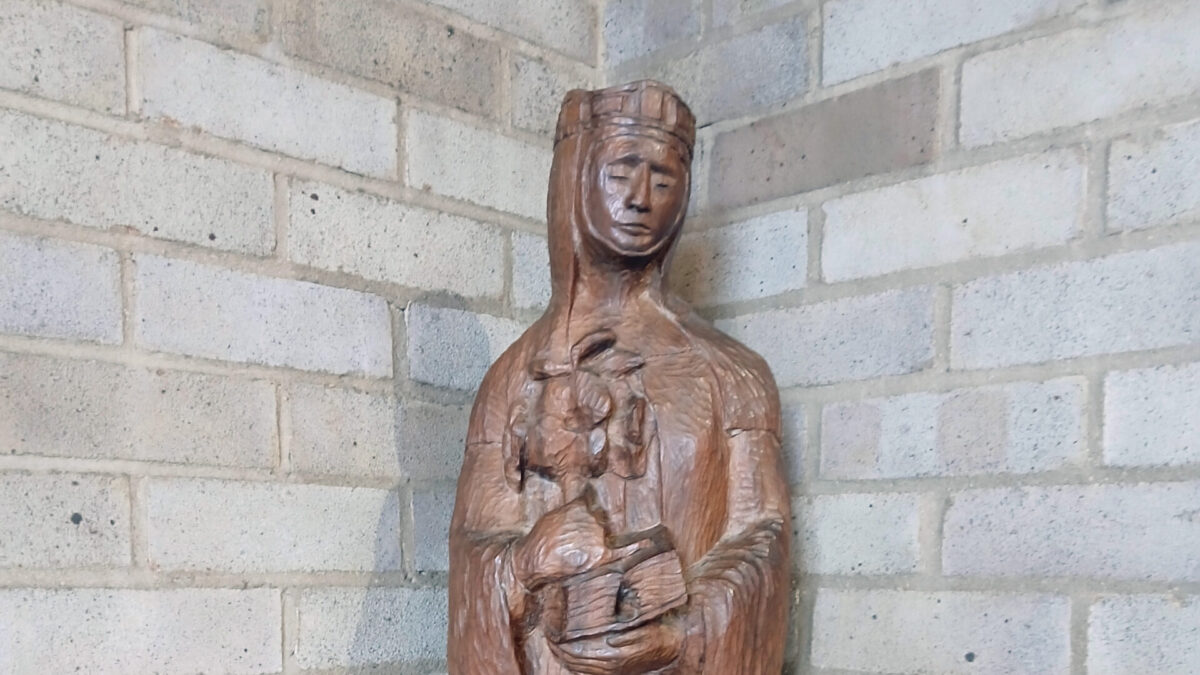
The Diocese of East Anglia is marking its 50th anniversary with a Jubilee of celebrations encouraging everyone to understand and perhaps explore the places, history and growth that have shaped Catholic life across the area covered by the Diocese. The places have been chosen to represent the breadth of historic and contemporary places of worship or pilgrimage across our geography.
The latest article in the series is written by Deacon Martin L’Estrange, who was part of a pilgrimage group from King’s Lynn parish. His report has some supplementary material added by Fr John Morrill.
The roots of pilgrimage to Ely go back to the early medieval period. Ely became a prominent pilgrimage site primarily due to the presence of its abbey, which was founded in the 7th century by St Etheldreda and housed her tomb. It became an important site of veneration due to her sanctity and the miracles attributed to her intercession.
St Etheldreda was probably born at Exning, near Newmarket, around AD 636 and was the daughter of King Anna of East Anglia. Also known as Æthelthryth and Audrey, she married twice. Her first husband died shortly after the marriage, and her second husband was King Egfrid of Northumbria. She persuaded both husbands to respect her virginity and her second husband to allow her to retire from worldly affairs and enter a convent. When he eventually agreed to her request, she became a nun at Coldingham on the east coast of Scotland, where she remained for a year.
In 673, Etheldreda moved to Ely, where she founded an abbey for both monks and nuns on the site of the current cathedral. As abbess, she led a life of piety and austerity until she died of plague in about 680. She freed all the bondmen on her estates and was always the last of her nuns to take a bath in a single tub of water and to be served with food. She was buried in the nuns’ cemetery according to her wishes. When, through popular demand, it was decided to move her to a more fitting tomb, it was found that, even after 15 years in wet earth, her body was still in a perfect state of preservation. When the Normans began building the present cathedral at Ely and moved her body in 1106, it was again reported to be incorrupt.
Almost immediately after this, miracles and healings were recorded, and Etheldreda’s shrine became a site of pilgrimage. The shrine had been destroyed in 860 during the Danish invasions, although the body of Etheldreda was left in place. According to the Liber Eliensis, a 12th-century chronicle of Ely, one of the Danes attacked the tomb, but his eyes immediately emerged from their sockets, and no one dared to touch the tomb after that.
The shrine was restored in 970 and became renowned as one of the most magnificent and wealthy shrines in the kingdom. In 1081, work began on the present cathedral building on the same site, and this became the new home for St Etheldreda’s shrine. As with St Edmund’s shrine at Bury, St Etheldreda’s shrine became part of the medieval royal pilgrimage tours; indeed, many ordinary pilgrims would visit as part of following pilgrim routes across East Anglia, most of which concluded at Walsingham. For example, King Henry VI visited the shrine in 1448 as part of his tour, which also included Bury St Edmunds, Norwich and Walsingham.
During the 12th century, the number of recorded miracles associated with the shrine reached a high, and the abbey became one of the key religious centres in medieval England. Ely’s location, surrounded by marshes, added to its sense of spiritual seclusion in an era before the drainage of the Fens. Pilgrims would traverse the fens and marshlands to reach the abbey, and the journey itself became part of the pilgrimage experience, symbolising the trials and tribulations of spiritual quests.
However, as with most pilgrimage centres, the dissolution of the monasteries marked the end of the shrine and of pilgrimage to Ely. In 1539, the monastery was closed and the cathedral rededicated to the Holy Trinity. A few years later, the shrine was destroyed. The site of the shrine, directly in front of the high altar, is now marked by a single marble slab laid into the floor with the legend ‘HERE STOOD THE SHRINE OF ETHELDREDA, SAINT AND QUEEN, WHO FOUNDED THIS HOUSE AD 673’. There is also a chapel dedicated to her, containing a modern stone statue, where pilgrims are encouraged to pray and to light candles for her intercession.
To venerate relics, one can go to the Catholic church less than half a mile from the cathedral. In 1811, a reliquary was discovered in a priest’s hiding hole in a Sussex farmhouse. It contained a left hand attached to an engraved plate with the inscription ‘Manus Sanctae Etheldredae DCLXXIII’. The plate has been dated to the period shortly after the Viking spoliation of the original monastery. This left hand of St Etheldreda was given to the Duke of Norfolk, who later passed it to the Dominican community at Stone in Staffordshire. It was eventually given to the Catholic Church of St Etheldreda, Ely, in June 1953, where it remains today, housed in a simple reliquary. (The church is at 19 Egremont Street, Ely, CB6 1AE.)
There is another Catholic church nearby dedicated to her: the Church of Our Lady Immaculate and St Etheldreda in Newmarket, close to the place of her birth. In its Lady Chapel stands a fine modern statue of the saint, carved in dark wood, which is well worth a visit.
Another relic from the hand is to be found in the church in central London dedicated to her, St Etheldreda’s, Ely Place. The church was part of the medieval palace of the Bishops of Ely and was intermittently used for Catholic worship during penal times. This relic, too, was found to be undecayed and is contained in a reliquary on the right-hand side of the altar.
Etheldreda is traditionally invoked for illnesses of the throat and neck, stemming from the story of her death from a tumour in her neck, which she accepted as divine retribution. Not without a touch of irony, she is considered a patron for widows, reflecting her own experiences of widowhood and her life of chastity and devotion after her marriages. She is also associated with the University of Cambridge, likely due to her historical and religious influence in the region and her connection to Ely, which played a significant role in education and ecclesiastical life.
Several parishes have made a Jubilee pilgrimage to Ely this year, as have parishes from elsewhere. Do consider bringing a party from your parish. There is so much else to see, as well as the opportunity to take a guided tour of the cathedral and visit the Catholic church for prayer in front of the relics of one of our greatest saints.