
Bishop Issues New Norms for Parish Pastoral Councils
July 2, 2026
Ordinations Bring Joy to the Diocese
July 5, 2026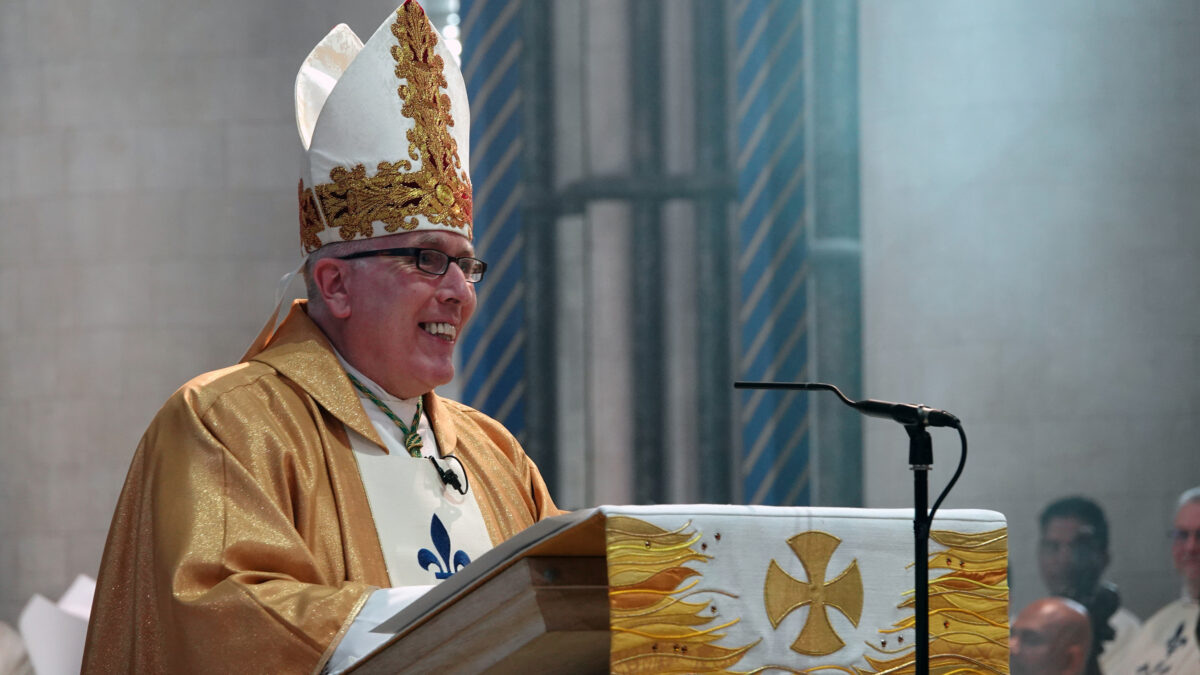
On 26 June the Diocese of East Anglia celebrated 50 years. Bishop Peter Collins presided over the celebratory Mass and delivered the below Homily.
The Diocese of East Anglia was established when Pope St Paul VI promulgated the Apostolic Decree Quod Oecumenicum on 13th March 1976.
The first Bishop of the newly erected Diocese, the Right Reverend Alan Clark, was installed on 2nd June 1976.
The ceremony was celebrated in this magnificent structure, which was built through the munificence of the 15th Duke of Norfolk, His Grace Henry Fitzalan Howard, and designed by George Gilbert Scott and his brother, Oldrid.
Last Friday I was present for an event at Arundel Castle and heard the present Duke allude to the generosity of his predecessor, who built three stunning Catholic churches that would all become cathedrals – Arundel (Diocese of Arundel and Brighton), Sheffield (Diocese of Hallam) and here in Norwich (Diocese of East Anglia).
Most appropriately, we are celebrating this Mass of Thanksgiving to mark the Golden Jubilee of our Diocese on the Solemnity of the Dedication of this, our Mother Church.
In listening to the Prophet Ezekiel, we are transported back to the early sixth century B.C. when the ancient southern Kingdom of Judah was about to suffer what had already been inflicted on the northern Kingdom of Israel: the loss of its ragged independence in advance of an inflicted exile in Babylon.
Despite inhabiting an era of great affliction, the prophet provides a depiction of the flow of divine grace.
Water flows to the east from the sanctuary of the Temple in Jerusalem, flows into the Kidron Valley and down to the Arabah, the Dead Sea, transforming its salted desolation into a spring of fresh water where life will thrive afresh.
The riverbanks and coastline will teem with abundant life.
This biblical vision of the waters flowing to the east is meant to represent the movement toward the Garden of Eden but, at the very least, we will assert that the eastward movement leads to the Garden of England – that is East Anglia.
Psalm 46, the first of the Zion hymns, is sung in praise of the Temple and proclaims that the waters of a river give joy to God’s city, the holy place, the abode of the Most High.
Even in the midst of affliction, destruction and loss, the faith of the Hebrew people proclaimed Jerusalem to be the peaceful ‘City of God’ amidst the chaos of the world.
I take this opportunity to remind you that the Diocese of East Anglia is twinned with the Latin Patriarchate of Jerusalem in recognition of the fact that we host ‘the Nazareth of England’ at Walsingham.
We must pray today, with great earnestness, that peace will reign, not only in the city of Jerusalem but across the Holy Lands, across the entire Near and Middle East.
In John’s Gospel, Jesus addresses the Samaritan woman at Jacob’s Well.
The Samaritans expected the long-awaited Prophet, the Messiah, to uncover the sacred vessels that were lost when the Temple was despoiled and destroyed by the Babylonians.
Jesus proclaims to the woman, and to the world, that the hour is coming; indeed, the hour is now here, when the great call to worship no longer references either the Temple in Jerusalem nor any gathering on Mount Gerizim in Samaria.
Jesus brings us to the hour, to the timeless moment, when true worshippers will worship the Father in spirit and truth.
In the Pauline Letter to the Ephesians we hear that God’s people must assemble in that arena where Christ Jesus himself is the cornerstone.
We do not gather today merely in a church; we gather as the Church.
With Christ as her cornerstone, the Church offers a cosmic universal embrace to the world.
The Letter to the Ephesians provides us with the reassurance that we are no longer strangers and aliens, but fellow citizens with the saints and members of the household of God.
With particular joy during our Golden Jubilee as a Diocese, we rejoice to declare that we are being built into a dwelling place for God by the Spirit.
In this moment of celebration we should take time to contemplate the true and abiding nature of the Church.
The unity of the Church universal is established in Jesus Christ and is sustained through the communion fostered and guided by the gift of the Petrine ministry.
Pope St Paul VI issued his first encyclical on the Feast of the Transfiguration in 1964 (it is worthy of note that Pope Paul died on that feast day in 1978), the letter being entitled Ecclesiam Suam, and the text begins with these words:
“The Church was founded by Jesus Christ to be the loving Mother of the whole human family and minister to its salvation.”
Pope Paul spoke of the essential vitality of the Church’s dialogue with the world, modelled on the noble dialogue of salvation itself, the dialogue between God and man.
It is in conversation with Christ, the Divine Word made flesh, that all truth is revealed.
Pope St John Paul II, in his Encyclical Letter entitled Ecclesia de Eucharistia, issued on Holy Thursday 2003, reminds the Church that she draws her life from the Eucharist, which can most rightly be described as the sacrament of the Paschal Mystery.
John Paul II calls us to wonder at what he describes as the great Eucharistic ‘amazement’, for the Lord says: “This is my Body. This is my Blood, which is given for you.”
Through the Holy Eucharist we recognise most fully that the Church’s mission stands in continuity with the mission of Christ.
“The Church is called during her earthly mission to maintain and promote communion with the Triune God and communion among the faithful … the Eucharist thus appears as the culmination of all the sacraments in perfecting our communion with God the Father by identification with his only begotten Son through the working of the Holy Spirit.”
Pope Benedict XVI, in his Encyclical Letter entitled Deus Caritas Est, issued on Christmas Day 2005, quotes St Augustine’s great work on the Holy Trinity, declaring that, “If you see charity, you see the Trinity.”
The voice of Pope Benedict reminds us still of the three-fold responsibility of the Church:
- To proclaim the Word of God.
- To celebrate the sacraments.
- To exercise the ministry of charity.
In another of his encyclicals, Caritas in Veritate, issued on the Feast of St Peter and St Paul in 2009, Pope Benedict says: “Charity in truth, to which Jesus Christ bore witness by his earthly life and especially by his death and resurrection, is the principal driving force behind the authentic development of every person and of all humanity.”
Charity is filled with truth and constitutes the essential grace for all integral human development and human solidarity.
Pope Benedict describes the proper entwining of human ecology and environmental ecology, an endeavour that is not merely materialistic but predominantly spiritual.
Pope Benedict offers us a powerful and pertinent statement when he says that, “A humanism which excludes God is an inhuman humanism.”
Without God we are ensnared by the fashions of the moment.
Pope Francis presented to the world his Encyclical entitled Laudato Si’ on the Feast of Pentecost in 2015.
Pope Francis reminded us all that, “The global climate is a common good, belonging to all and meant for all.”
As stewards of creation, we are all duty-bound to adhere to the guidance of sobriety and humility.
Sobriety and humility bring satisfaction and fulfilment to the human condition, enabling us to resist the technocratic dehumanising paradigms of our age.
Our Holy Father, Pope Leo XIV, has recently offered to the Church and to the world an Encyclical Letter that is truly profound and providential, Magnifica Humanitas.
“Humanity, created by God in all its grandeur, is today facing a pivotal choice: either to construct a new Tower of Babel, understood as the structures of discord and confusion, or to build the city in which God and humanity dwell together.”
“The pervasive technocratic paradigm in which we are immersed, and that is amplified by the digital revolution and especially by artificial intelligence, threatens to normalise an anti-human vision.”
We must confront the culture of power, for man is not an object to be manipulated or a mere resource to be optimised.
We must build and defend the civilization of love and hold fast to the principles of ‘realism’, avoiding both ‘idealism’ and ‘cynicism’.
The indulgent individualism in current fashion is leading to a disconcerting loss of historical memory.
The loving God descends into our history in order to free us from all forms of slavery, for it is in Christ alone that we can fully contemplate the grandeur of our humanity, for it is within us that Christ has made his dwelling place.
Before my own appointment to East Anglia, my relationship to this region was somewhat limited.
I had served as officiating chaplain to the soldiers of the Royal Anglian Regiment when they established their barracks within my parish at Chepstow.
I had very occasionally visited Norwich and Cambridge for conferences.
I did not have the privilege of ever meeting Bishop Alan Clark. I can claim a tenuous connection with him in as much as he was ordained as an Auxiliary Bishop on 13th May 1969, the day on which I celebrated my eleventh birthday.
There is another connection, for Bishop Clark was the first Co-Chair of the Anglican Roman Catholic International Theological Commission, established by Pope Paul VI and Archbishop Michael Ramsey, and I have a modest role in fostering Anglican Roman Catholic dialogue here in England and Wales and across the world.
I came to know well Bishop Peter Smith once he was translated from East Anglia to become Archbishop of Cardiff.
I also knew Bishop Michael Evans, for we were both serving as seminary Vice-Rectors in the 1980s and 1990s.
I encountered my beloved predecessor, Bishop Alan Hopes, here present with us today, on a few occasions through the auspices of Archbishop George Stack, Emeritus Archbishop of Cardiff. I am happy to say that we usually met so as to enjoy a shared meal.
I was blessed in being appointed as the fifth Bishop of East Anglia in 2022 and I am delighted to say that I am fully rooted in my new home.
Across the years I had met, or had some knowledge of, a small number of priests from East Anglia.
For example, I knew well the reputation of Monsignor Tony Rogers, who served as Diocesan Administrator between Bishop Peter and Bishop Michael.
Let me now highlight the fact that the deacon who proclaimed the Gospel at the installation of Bishop Clark on 2nd June 1976 was the Reverend David Bagstaff, now Canon Bagstaff, our much loved and respected Senior Vicar General, who himself served as Diocesan Administrator between Bishop Michael and Bishop Alan Hopes.
Canon David was the first priest to be ordained for the new Diocese and will be celebrating his own Golden Jubilee on 7th July.
*** I then called on Canon David to stand and receive the applause of the congregation.
My dear people, whatever age you are, you will have your own treasured memories of the diocesan family and of your parish communities across the past 50 years.
We have gathered here from our three counties in joyful recollection of days past and in confident anticipation of the days that lie ahead of us.
We have gathered from the channelled waters of the Cambridgeshire Fens to the meandering Broads of Norfolk and Suffolk; from the expanse of our agricultural fields to the environs of world-famous academia and centres of technological innovation; from spectacular, though fragile, coastline to the towering majesty of medieval cathedrals and churches.
This is our beloved part of God’s world; this is our beloved Diocese.
Here, in this place, at this time, we are called to witness to the Gospel of Jesus Christ, called to service in building the peaceful City of God amidst the chaos of the world.
We can rejoice, for we are being built into a dwelling place for God by the Spirit.
Amen.