
Fr Peter: Paris Gathers for Papal Mass
September 27, 2026
Praise and Worship Evening in King’s Lynn
September 28, 2026
Monsignor Anthony Rogers traces the growth of the Catholic communities in Cambridge and St Ives from small and often persecuted beginnings to the thriving, diverse parishes of today.
In mediaeval times, the town of Cambridge – it didn’t acquire city status until 1951 – boasted thirteen colleges of the University, all religious foundations, and sixteen parishes. But it was a town that embraced the European Reformation, to the extent that it was referred to from the 1520s onwards as ‘Little Germany’, thanks to the support of figures such as William Tyndale, Thomas Cranmer and Hugh Latimer for Lutheran ideas.
But, by the century before Catholic Emancipation in 1829, the small number of Catholics in the area found that good sense and humanity on the part of the authorities left them, for the most part, undisturbed. A mere handful of individuals was unlikely to pose a threat to the government of the day or the established Church of England. A Jesuit priest resided at Sawston Hall, and Catholics living within reach were admitted to Mass.
From the 1820s onwards, various hopes of establishing a mission were expressed, but nothing bore fruit until the acquisition of land in Union Road and the subsequent building of a church dedicated to St Andrew, designed by the architect Augustus Welby Pugin and opened in 1842. Missions were not territorial but gave those living within striking distance the opportunity to go to Mass. Those in charge of the missions were called ‘missionary rectors’. Parishes, as we know them, with defined boundaries, were not established until 1918.
The native Catholic population of Cambridge and the surrounding district was minuscule, but some Irish people came to work in the area before the Great Famine of 1849 because, although not starving, they were nonetheless poor and in search of a better life. Some stayed permanently, while others came as seasonal workers on the land, to drain the Fens or to build roads. When St Andrew’s Church was opened, a regular congregation of about a hundred came to Mass.
Anti-Catholic feeling in the area was strong, and there were various attempts to vandalise the new church. However, the Vicar of St Paul’s Church nearby, who shared those sentiments, was gracious enough, upon his departure to become Bishop of Melbourne, to remark that during his ministry in the area he had ‘made every effort to put down popery and failed’. Nevertheless, he recognised that the Catholics were there to stay and hoped that all would learn to live in peace with one another.
Between 1843 and 1961, the community was served by just four missionary rectors or parish priests, namely Canons Quinlivan, Scott, Marshall and Stokes. Catholic undergraduates were served by chaplains living at the Rectory in Hills Road, St Edmund’s House and, ultimately, Fisher House.
St Laurence’s Parish
Our Lady and the English Martyrs (henceforth referred to as ‘OLEM’) served the whole town and surrounding villages. But, by the 1920s, a need was felt for the provision of Mass for those living north of the River Cam. This was first provided by the community and chaplain at the Carmelite convent established in 1925. By 1937, the sisters had found it to be too noisy a site, and they moved to Waterbeach.
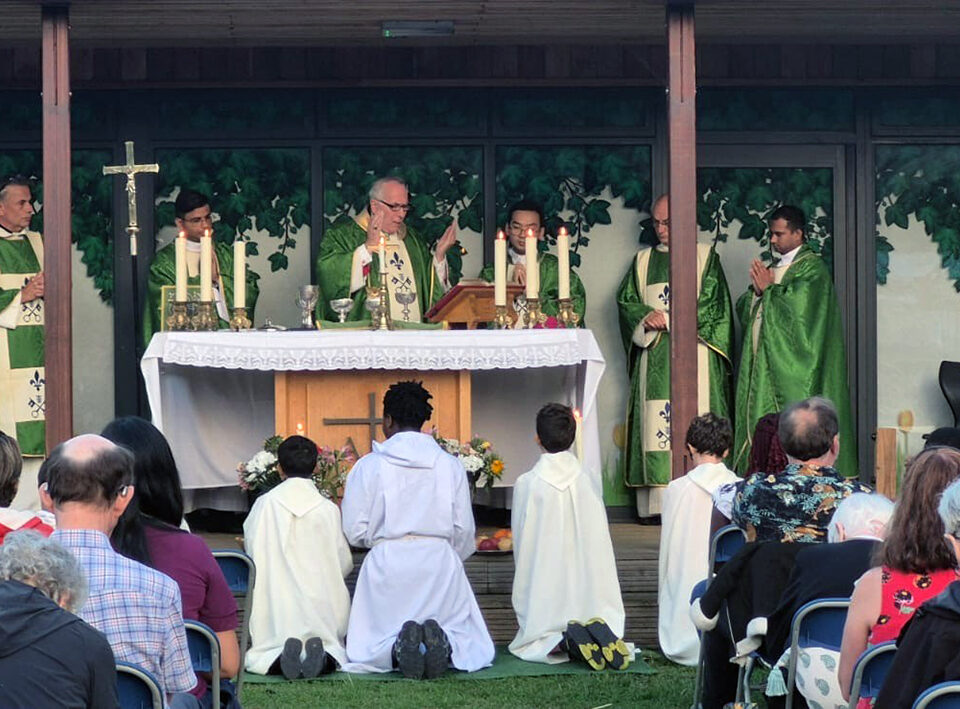
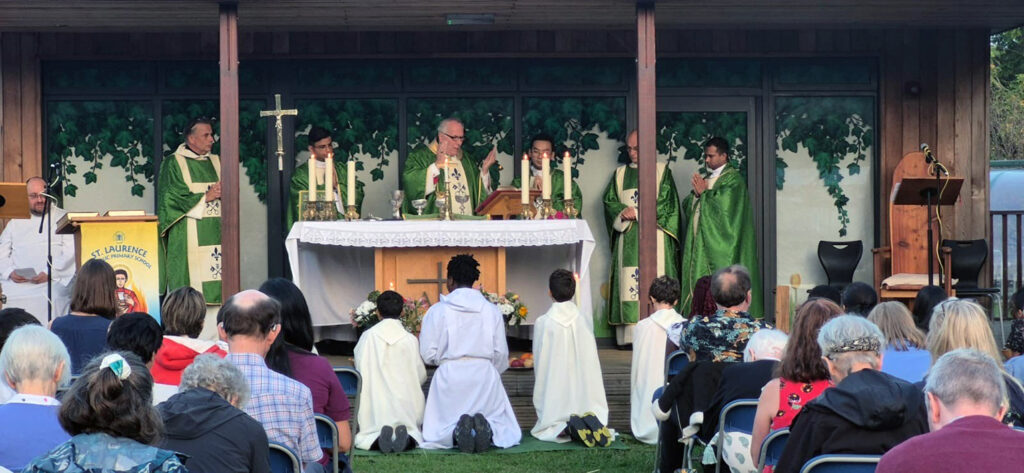
Through the generosity of a donor, provision was made for a modest church to be built in the area. A prefabricated building – often called a ‘tin tabernacle’ when used as a church – had begun its life as a ward in the huge Great Eastern Field Hospital, providing care for wounded servicemen during the First World War, and later served as the Catholic Men’s Club. It was moved to the High Street in Chesterton in 1939 and served the community until it, in turn, was replaced by the permanent brick building in Milton Road, completed in 1958 and dedicated, like its predecessor, to St Laurence. Its final destination was Ditton Lane, where it serves the thriving local community as St Vincent’s.
St Philip Howard Parish
Development on the southern side of the city was slower and, before the building of the church in 1978, Mass centres were to be found in various places, ranging from St Bede’s School to St Mary’s Church, Linton, and St Vigor’s, Fulbourn. The site for the present church had been bought from the council for £750 but lay dormant until the 1970s when, following a series of meetings with the parish priest at OLEM, Canon Paul Taylor, about the wisdom and feasibility of building a new church, a decision was taken to proceed with a dual-purpose building.
Though not prepossessing to look at, the church was to have bespoke sanctuary furniture, with commissioned artwork by Anton Wagner, a Norfolk-based, Oberammergau-born woodcarver. Over the years, the parish grew, with a large influx in the early 21st century of people from Europe, Africa and Asia, with the Keralan Syro-Malabar community forming the largest group.
Thanks to the hard work of parishioners and financial support from John Latham Senior and Junior, Fr Philip, the parish priest, was able to proceed with an ambitious rebuilding programme. The church closed in January 2025, and the parish returned on Palm Sunday 2026 to the fine, modern Syro-Malabar and Latin-rite building gracing Cherry Hinton Road.
Religious communities
The academic pull of the town and increasing pastoral needs brought, over the years, a number of religious communities. Male religious included Dominicans, who remain a prominent Catholic presence in their priory off Huntingdon Road; Franciscan Friars Minor; De La Salle Brothers; Irish Christian Brothers; Jesuits; English Benedictines; and, since 2024, the Adorno Fathers, who have pastoral care of St Laurence’s.
Female religious have been part of life in all three parishes, with the Congregation of Jesus, Dominicans and Daughters of Divine Charity currently in English Martyrs Parish, and the Holy Family Sisters at Hope House. The Canonesses of St Augustine and Adoration Sisters were also present until recent times. In St Laurence’s Parish were the Carmelites, while in St Philip Howard Parish were the Sisters of Our Lady, previously at St Edmund’s House, and the Religious of Jesus and Mary. All have, in different ways, contributed much to the Catholic community.
Schools
St Andrew’s all-age school, for pupils from Reception to age 15, was the only state school until the building of St Bede’s Secondary School in 1962 and St Laurence’s Primary School in 1968. With falling numbers in the 1980s, the future of St Bede’s did not look secure. However, imaginative thinking on the part of Mgr Paul Hypher and others, together with a partnership with the Anglican Diocese of Ely, resulted in the establishment in 1988 of St Bede’s Inter-Church School, now a thriving place of education with approximately 950 pupils.
Some concluding thoughts
Almost three and a half thousand Catholics go to Mass on Sundays, with a further 300 in St Ives. This is a far cry from the 100 or so in both places when Mass was first celebrated regularly. Until the beginning of this century, the majority of Catholics who were not English and came from Ireland – the overwhelming number of whom came from about six villages in North Mayo – Italy and Poland. Theirs were the names that resonated in our schools.
But our community is now truly international, and we are much the richer for it. In earlier days, hostility towards Catholics was evident. However, in the latter years of the 20th century, the Catholic parishes in the Cambridge and Sawston area were able to celebrate Mass in no fewer than seven Anglican parishes – evidence of barriers broken down and bridges built. With increased lay involvement and initiative, under God’s grace, we grow in his way.
St Ives
In 1890, St Andrew’s Church was replaced by what is known as OLEM, the building of which was made possible through the generosity of Mrs Yolande Lyne-Stevens, widow of a man reputed to be among the richest in England, who had amassed his fortune through his glassmaking business. The only artefact from the Pugin church to be incorporated into the new building was the St Andrew’s cross.
Bizarrely, the old church stood redundant next to the new one for twelve years. In 1902, it was demolished and transported by river to St Ives, then in the county of Huntingdonshire, at the expense of George Pauling, a local benefactor. The Cambridge white bricks were replaced with red ones, and most of the internal fittings, including the altar screens, were sold. The most important survivals from St Andrew’s, rededicated to the Sacred Heart, were three stained-glass lancet windows.
Like Cambridge and other towns in Fenland, Catholicism was, for a time, almost extinguished in St Ives. While Cambridge itself had an influx of Irish workers early in the 19th century, it was not until the latter part of the century that drovers began coming regularly from Ireland and Lancashire to the cattle markets in St Ives, expressing the hope that Mass would be provided.
The same George Pauling who had facilitated the removal of St Andrew’s Church secured some land and a small wooden building that served the people until the Pugin church was rebuilt. Thereafter, the community grew and, since 1900, it has been served by fourteen different priests.