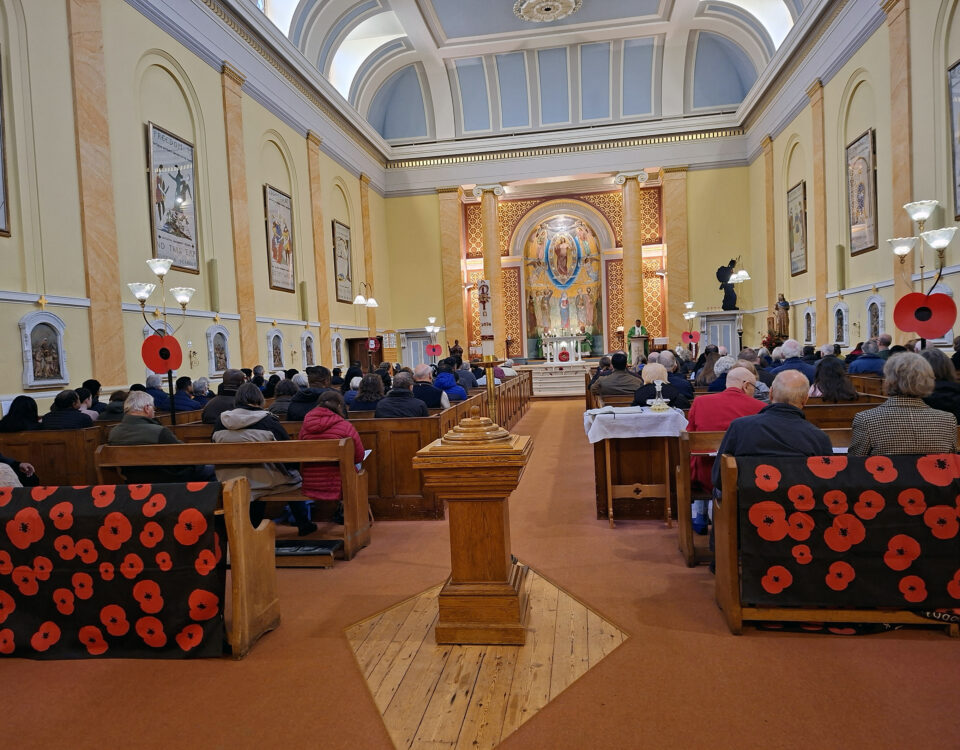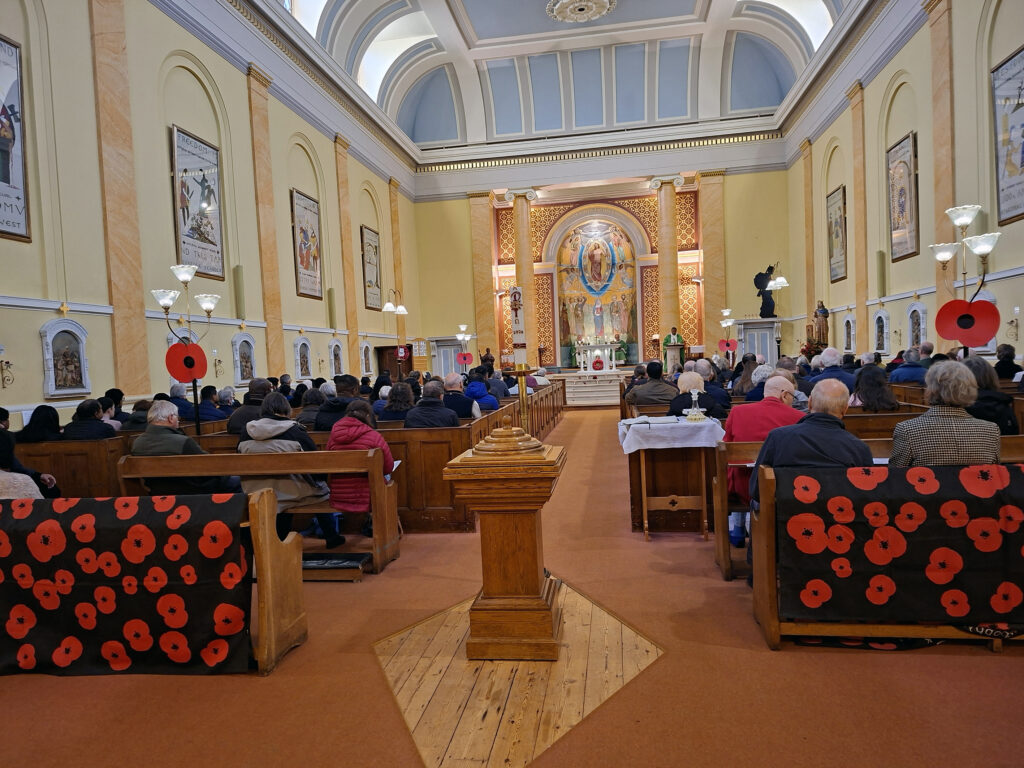

St Edmund’s Parish Remembers the Fallen
November 20, 2026Unity Corner: Pioneers of Christian Unity
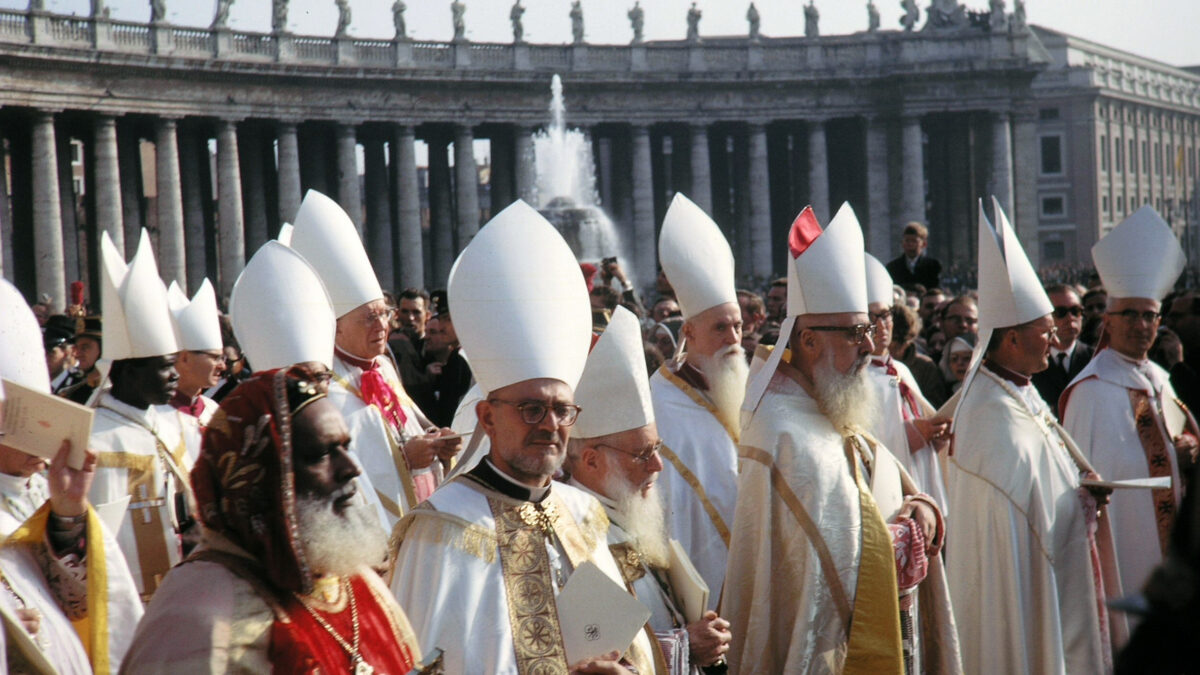
Bishops gather in St Peter’s Square for the opening of the Second Vatican Council in October 1962. Photo: Peter Geymayer.
Unity Corner is a regular feature on Christian unity by Dr Ian Watson, a lay Catholic and the County Ecumenical Officer for Norfolk and Waveney. In this reflection, he considers what the often-forgotten pioneers of Catholic ecumenism can teach us about patience, perseverance and hope in the search for Christian unity.
Recently, I found myself working through a chapter by Peter De Mey and Saretta Marotta in A History of the Desire for Christian Unity. It was not the sort of thing I would normally pick up for leisurely reading! The chapter tells the story of the Catholic Conference for Ecumenical Questions, an international network of theologians, priests and bishops that emerged in the 1950s and helped shape ecumenical thinking within the Catholic Church.
At first, it felt like a specialised exercise in ecclesiastical history, full of conferences I had never heard of and letters between people whose names rarely surface in parish life. I will admit it was heavy going in places. As I persevered, though, a story emerged about how the Church learned to engage with Christian unity before the Second Vatican Council. To my surprise, much of it was a story of disagreement and argument.
All this was happening before Unitatis Redintegratio, Vatican II’s 1964 decree on ecumenism, and before dialogue with other Christians had become a familiar part of Catholic life. Those involved were wrestling with difficult questions. How should Catholics relate to other Christians? What place should dialogue have in the search for full communion? Could real engagement happen without weakening Catholic conviction? To me, it was that last question which proved the hardest to settle.
Among those seeking answers were Johannes Willebrands, the Dutch priest who later became a cardinal; Yves Congar, the French Dominican whose theology did so much to shape the Council; Christophe-Jean Dumont of the Istina Centre in Paris; and the German Jesuit Augustin Bea, first President of the Secretariat for Promoting Christian Unity. They shared a conviction that Christian division could not be accepted as a permanent fact of life. About what should be done, they were often far from agreed.
I suspect few Catholics today have heard much of these men, and (admittedly) before reading the chapter I knew less about some of them than I ought to have done. Willebrands, who would himself go on to lead the Secretariat, always felt that Divine Providence had given him the idea for the Conference, while also feeling ‘powerless and worthless to be given such a responsibility’. As a County Ecumenical Officer, I recognise something of that feeling, although on a much more modest scale!
Reading on, I was soon cured of any notion that the Catholic approach to ecumenism arrived fully formed. Some worried that closer contact with other Christians might blur important theological distinctions. Others were convinced that only encounter and dialogue could overcome centuries of mistrust. A meeting at the abbey of Grottaferrata, near Rome, in 1950 brought these tensions into the open. Its main purpose was to bring independent Catholic ecumenical initiatives into line with Roman directives, with a firm warning against ‘false irenicism’, the playing down of doctrinal differences for the sake of peace. Yves Congar came away with what he called ‘a very vexing impression’. Of a proposal for a new international ecumenical body in the Vatican, he warned that ‘if the thing comes to Rome, it’s death!’
Even so, the contacts made at Grottaferrata helped prepare the ground for later developments. The concern for doctrinal integrity also endured, and Unitatis Redintegratio would insist that ‘nothing is so foreign to the spirit of ecumenism as a false irenicism’ (§11). Personally speaking, I think the Council was right, and it was right for the sake of unity itself. In the same prayer in which Christ asked that His disciples ‘may all be one’, He also asked the Father to ‘sanctify them in the truth’ (John 17:17). A unity reached by agreeing that our differences no longer matter would not be the unity Christ prayed for. It would also fail to respect our fellow Christians, whose convictions deserve to be taken as seriously as our own.
That said, none of this needs to become a brake on unity. In the same paragraph, Unitatis Redintegratio asks Catholics to explain their faith in terms other Christians can genuinely understand and reminds them that there is a ‘hierarchy’ of truths, since not every doctrine stands in the same relation to the foundation of Christian faith. In other words, honesty about what divides us is matched by care in how it is expressed. That, it seems to me, is the balance the pioneers of the 1950s were struggling towards.
I take more than comfort, then, from how hard these people argued. Christians do not argue that fiercely about things they consider unimportant. Those who urged caution feared a unity bought at the expense of truth, while the more eager were afraid that an anxious defence of truth would leave Christians estranged for good. Each was guarding something the other needed, and the Church needed both. The philosopher Alasdair MacIntyre describes a living tradition as one sustained by an ongoing argument about the goods that give it purpose. Here I found that idea at work, as the Catholic tradition argued its way towards a deeper understanding of what faithfulness to Christ required. The real enemy of Christian unity is an indifference that treats our differences as no longer worth discussing. False irenicism is, in the end, a polite form of that same indifference.
What moves me is that the arguments did not drive these people apart. Priests travelled across Europe to meet one another, and theologians exchanged letters and drafts. Plans stalled and hopes were sometimes dashed. Congar himself was forbidden to teach in 1954 and sent away from Paris. He obeyed and went on working, but less than a decade later he was among the theologians shaping Vatican II. Through all of this, their trust may have grown slowly, but their disagreements were held within relationships strong enough to bear them, which is why, I think, they proved so fruitful.
I believe this is how the Holy Spirit often works. We remember the councils and the great documents, but much of the groundwork for these is laid through years of hard, persistent and patient effort that hardly anyone remembers. I see something similar in my own work, where some local Churches Together groups and ecumenical partnerships have lost touch with the stories of the people who had to argue and fight to establish them. In this context, local ecumenism also faces its own version of the danger Grottaferrata warned against. Friendship between churches can settle into a politeness in which our differences are never mentioned for fear of spoiling the atmosphere. That may feel like unity, but it rests on less trust than it appears to.
Nevertheless, the story of these Catholic pioneers gives me hope when the search for unity feels frustratingly slow. They could hardly have foreseen where their work would lead. They were simply trying, in the circumstances of their own time, to respond faithfully to Christ’s prayer ‘that they may all be one’ (John 17:21). What looks modest in one generation may prove decisive in the next. Christ told His disciples that ‘others have laboured, and you have entered into their labour’ (John 4:38). That is where all of us working for unity stand today.
What we have inherited from these forgotten pioneers includes the habit of honest argument held within friendship. Christian unity will not come from deciding that our differences no longer matter. It is being prepared, as it was in the 1950s, by Christians who take one another’s convictions seriously enough to argue about them and who go on meeting while they do. That road is slower than most of us would like. I am convinced, though, that it is the only one that leads to the unity for which Christ prayed.
Chapter reference
De Mey, P. and Marotta, S. (2025) ‘The Catholic Conference for Ecumenical Questions’, in Ferracci, L. (ed.), A History of the Desire for Christian Unity: Ecumenism in the Churches (19th–21st Century). Volume II: Paths towards Communion. Leiden and Boston: Brill, pp. 505–544.