
Putting the ‘Hallow’ Back in Halloween
November 12, 2025
Discover the Duckett Library: Faith and Learning
November 14, 2025
Unity Corner is a regular feature on Christian Unity by Dr Ian Watson, County Ecumenical Officer for Norfolk and Waveney. Here he discusses the scriptural foundation for Christian unity.

When out and about I’m sometimes asked what the scriptural basis is for ecumenism. In answering I mostly refer to John 17:20–23. Here, in His high priestly prayer, Jesus says:
“I do not ask for these only, but also for those who will believe in me through their word, that they may all be one, just as you, Father, are in me, and I in you, that they also may be in us, so that the world may believe that you have sent me. The glory that you have given me I have given to them, that they may be one even as we are one, I in them and you in me, that they may become perfectly one, so that the world may know that you sent me and loved them even as you loved me.”
I find this passage wonderful and (for the most part) persuasive. It is certainly the one most people use to justify ecumenism. It underscores unity as a reflection of the divine relationship and its purpose in witnessing to the world. However, it is not the only passage we can refer to, as the theme of unity is woven throughout Jesus’ teachings in John’s Gospel.
For example, in John 10:16 Jesus says, “And I have other sheep that are not of this fold. I must bring them also, and they will listen to my voice. So there will be one flock, one shepherd.” And in John 13:34–35 Jesus gives a new commandment: “Love one another. As I have loved you, so you must love one another. By this everyone will know that you are my disciples, if you love one another.”
For me, these passages in John portray love as the fundamental bond that unites the disciples of Christ. They also indicate that unity among believers is not just a horizontal relationship but is deeply vertical, namely, rooted in Christ Himself. In John 15:5 Jesus says, “I am the vine; you are the branches. If you remain in me and I in you, you will bear much fruit; apart from me you can do nothing.” In John’s Gospel it is clear that Christian unity is meant to reflect the relationship within the Trinity – a unity that is divine and grounded in the shared love and life of the Father, Son, and Holy Spirit.

There are other biblical passages from the Synoptic Gospels that also emphasise unity among Jesus’ followers. Even though they tend to have a different flavour from those in John’s Gospel, they all underscore the importance of Jesus’ teachings that direct His followers towards a unity that transcends individual differences, rooted in their common relationship with Him.
For example, in Matthew 18:19–20 Jesus says, “Again, truly I tell you, if two of you agree on earth about anything they ask, it will be done for them by my Father in heaven. For where two or three are gathered in my name, I am there among them.” This verse highlights the power and presence of unity in prayer and community.
In Mark 9:50 Jesus advises, “Have salt among yourselves, and be at peace with one another.” This call to peace urges all disciples to cultivate unity and harmony in their relationships.
And in Luke 9:49–50, when John expresses concern about someone casting out demons in Jesus’ name, Jesus responds, “Do not stop him, for whoever is not against you is for you.” Here Jesus’ openness suggests a broader notion of unity among those who work in His name, encouraging acceptance and cooperation.
Adding to the Gospels, of course, are St Paul’s letters, which are prolific in arguing for Christian unity.
For example, in 1 Corinthians 1:10 Paul appeals for unity, urging believers to “agree in what you say” and to avoid divisions, highlighting the necessity of concord among the faithful.
In Ephesians 4:1–6 he writes about maintaining the “unity of the Spirit through the bond of peace,” describing one body, one Spirit, one hope, one Lord, one faith, one baptism, to emphasise the fundamental unity in the Church.
In Philippians 2:1–2 Paul encourages believers to be “of the same mind” and “having the same love, being in full accord and of one mind,” promoting unity through humility and shared purpose.
And in Colossians 3:14–15 Paul urges believers to “put on love, which binds everything together in perfect harmony,” and to let peace “rule in your hearts,” as members of one body.
What, then, can we glean from these scriptural passages to guide our thinking on Christian unity? Well, together, I believe they help us identify the key essentials for unity.
I can sum these up as follows. In John, unity reflects the divine relationship that serves as a witness to the world. Here, the love of Christ is the fundamental bond among Christians. The Synoptic Gospels underscore unity through prayer, community, tolerance, peace and acceptance. While Paul’s letters urge believers to avoid divisions, have mutual respect, be humble, have a shared purpose, and maintain the “unity of the Spirit”.
I am greatly encouraged that the Roman Catholic Church has a strong commitment to ecumenism based on this scriptural understanding. Informed by Tradition and the guidance of the Holy Spirit, this commitment is not new and has been present throughout history, encapsulated by the early Church Fathers, which we can see in the teachings of Saints Ignatius, Irenaeus, Cyprian, Augustine and Athanasius.
Despite the somewhat bumpy ride through subsequent schisms and various major theological disputes, this commitment remains in contemporary Church thought, especially since the Second Vatican Council.
Demonstrative of this is Unitatis Redintegratio (1964). This decree on ecumenism, which emerged during Vatican II, emphasises the importance of unity by acknowledging that divisions among Christians contradict Christ’s will and scandalise the world. It calls for dialogue, mutual understanding, and cooperation among all baptised Christians.
This position is reflected in the Catechism of the Catholic Church (CCC 820–822), which expands on the necessity of unity, stating, “The desire to recover the unity of all Christians is a gift of Christ and a call of the Holy Spirit.” It goes on to encourage prayer, dialogue, ecumenical formation, collaboration, and fraternal knowledge among Christians.
Several Papal Encyclicals also encourage ecumenism. For example, in Ut Unum Sint (1995) Pope John Paul II urges all Christians to work together in overcoming divisions to achieve unity. Pope Francis, in Evangelii Gaudium (2013), calls for a commitment to ecumenism as part of the Church’s evangelising mission. In Laudato Si’ (2015) Francis specifically argues that care for creation provides a unique opportunity for ecumenical collaboration. As an aside, this was surely a major encouragement for King Charles to pray alongside Pope Leo at a recent ecumenical service in the Sistine Chapel – the first time a monarch of our country has prayed publicly with the Pope since the Reformation!
Whether or not many practising Catholics recognise it, the Roman Catholic Church clearly sees Christian unity not as a peripheral issue, but as essential to the mission of witnessing Christ to the world. It rightly encourages all the faithful to be focused on healing historical wounds, to learn from one another, and to work together in areas of mutual concern, such as social justice and moral issues.
As County Ecumenical Officer (and a practising Catholic myself), I am very much sustained by how the Church views ecumenism, which, at least in my opinion, encapsulates the scriptural grounding for Christian unity in the passages I have highlighted.
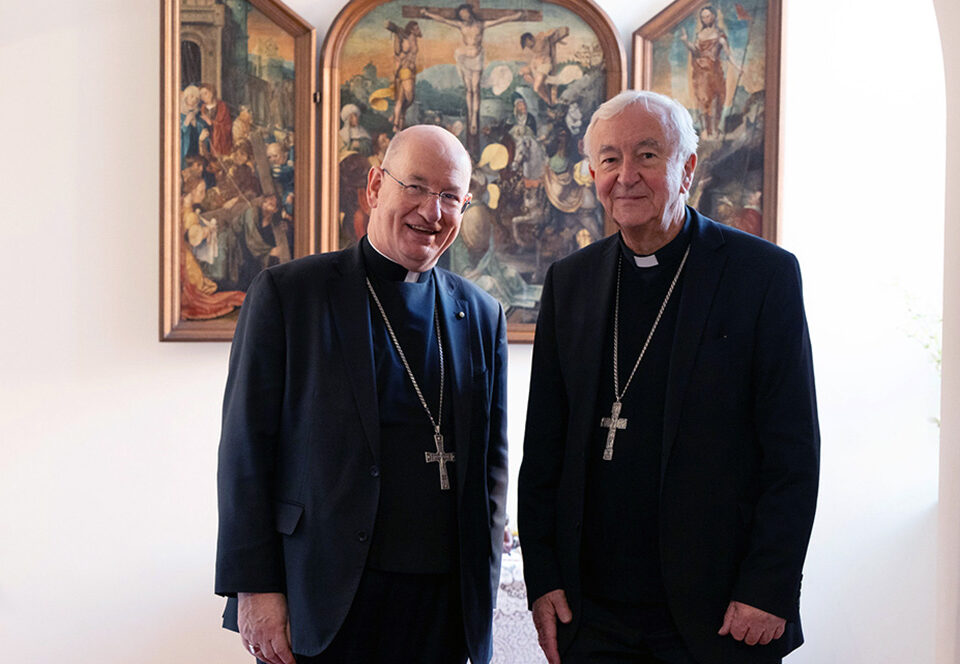
Article and images by Dr Ian Watson, whose lay views are his alone.