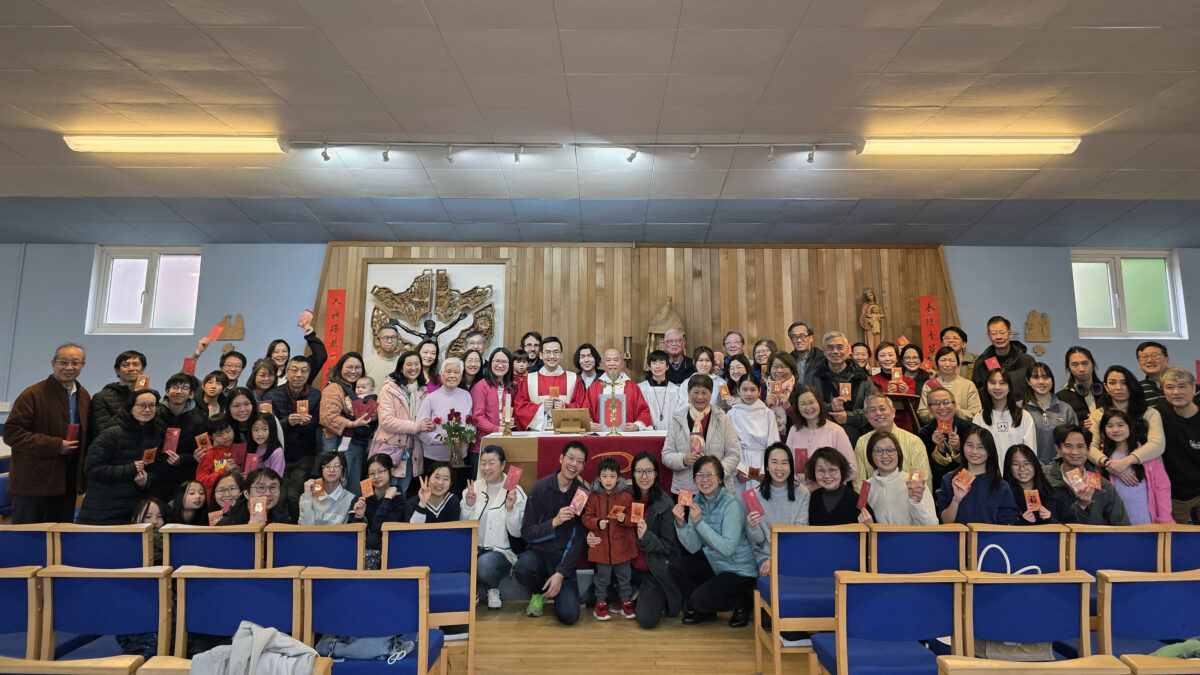
The day began with a Thanksgiving Mass in Cantonese. The celebrant was Canon John Minh, parish priest of Our Lady of Lourdes and St John Fisher, Cambourne. Canon John has been celebrating Mass in Cantonese since 7 April 2022 and can now be described as an “old hand”. On this occasion he was assisted by Deacon Peter Ho, who will be ordained to the priesthood in July 2026.
Although we are in Lent, the vestments were red – an auspicious colour for Chinese people. Red may also be seen as representing the blood shed by the Catholic Martyrs of China, known and unknown, canonised or not.
For Deacon Peter, it was his first ever proclamation of the Gospel in Cantonese, and he also delivered the homily in Cantonese. The congregation was impressed by his missionary zeal and his willingness to take part despite having less than a day to practise, fitting preparation in between his training days at St Mary’s Oscott Seminary in Birmingham and his parish pastoral work.
Indeed, the Cantonese community were so appreciative of his gracious effort that we offered to sinicise his name, which he has since accepted. He will henceforth be known to us as: Revd Deacon 何 (Ho) 庇德 (Peter). The two characters rhyme with Peter. 庇 means guarding or protecting; 德 means virtues – particularly Faith, Hope and Charity. We look forward to July when we can begin addressing him as Revd Father 何庇德!
Our Lunar New Year celebration is not merely about eating, drinking and being merry. For Hong Kong Catholics it blends an ancient tradition with Lenten devotion, reflection and penitence. It is about giving thanks for another year of love and care between and among the generations; about making amends in broken relationships and being reconciled with one another; and above all about gratitude for the redemption that Christ Jesus has brought and continues to bring to us all.
Like the reflections of Lent, the Lunar New Year invites us to think and live anew, casting off the old and embracing the new. 日新又新 (Renewal). It calls us to be more fully engaged in almsgiving and prayer, as was prayed in the Collect.
In the liturgy, the first reading was from Genesis (1:27–31). Even though our cultural lineage stretches back thousands of years, we recognise that everything began with the Almighty, our Creator. Our joy and gratitude were further reflected in the responsorial Psalm (Psalm 100:1–5). This theme of entrusting ourselves to God continued in St Paul’s letter to the Philippians (4:4–9). Deacon Peter then proclaimed the Gospel of John (1:1–5; 9–12). In his homily, he explained that Jesus’ unique genealogy reveals His origin: He was with God in the beginning. Through His incarnation He came as the light of the world, and we who believe in Him and follow Him are called to live as worthy children of God.
The Mass concluded with a solemn blessing, imploring God to keep and guide us through the Year of the Horse and beyond, granting us strengthening faith, persevering hope and unwavering charity.
Before the community moved to the parish hall to begin their traditional festivities, Canon John distributed to everyone a red envelope (laisee) containing a prayer card. This symbolised his role as our pastor, caring for our growing “faith-based family”. Traditionally, at Lunar New Year elders give red envelopes to the younger members of the family.
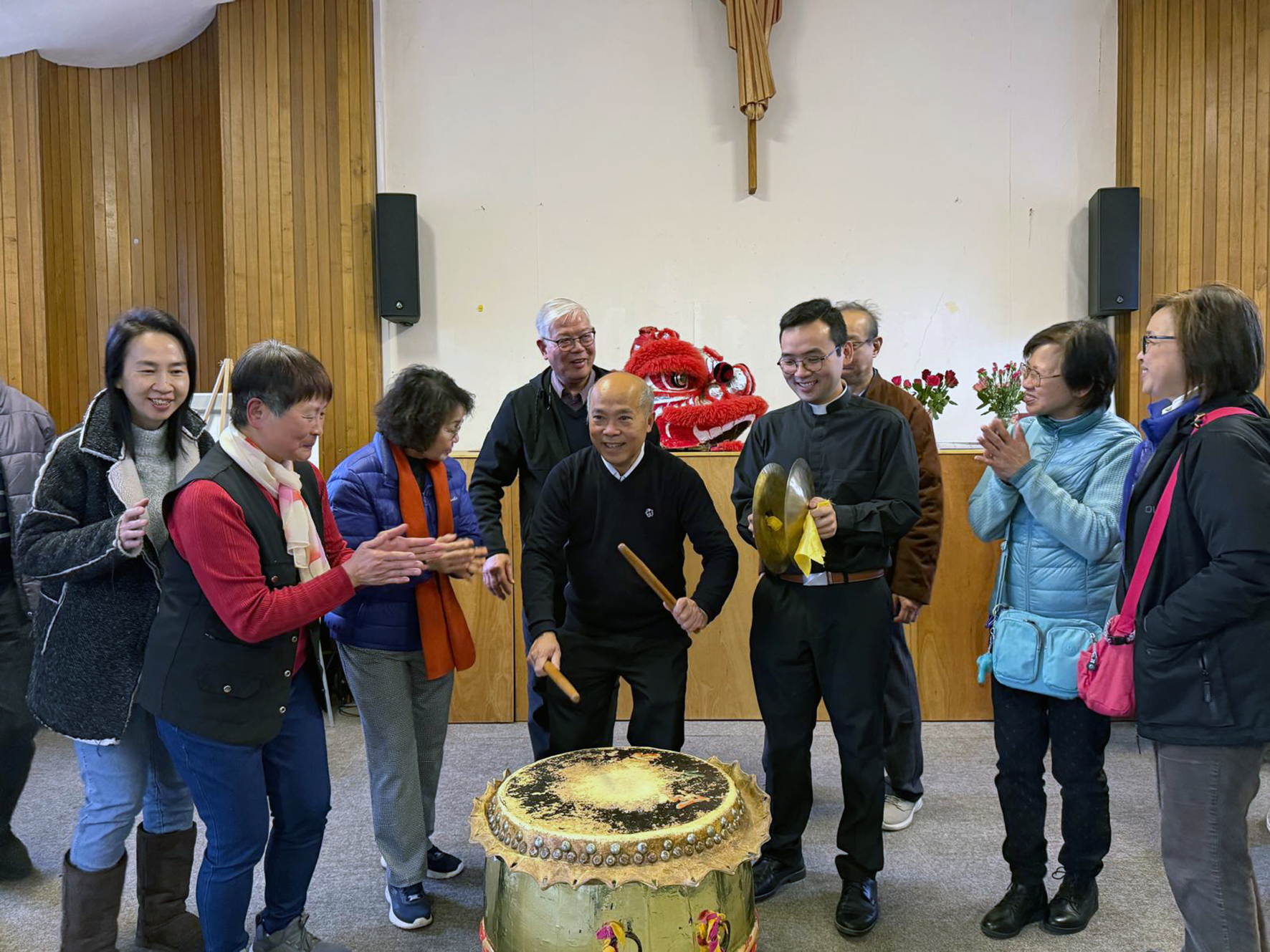
A lively traditional celebration began in the hall with a lion dance. The troupe ensured that the first act was to bow in veneration before the Crucifix on the wall.
The drumbeat and the clanging of cymbals soon roused the lion from its stupor, and everyone – young and old alike – watched with delight at how well the amateur dancers performed. Many joined in, and even Canon John and Deacon Peter had a turn at beating the drum.
Next came the solving of riddles – a subtle and witty quiz game enjoyed for thousands of years. Among the riddles were some with biblical connections, alongside proverbs and the names of places in Hong Kong familiar to many at the party. This reflected our determination that cultural traditions can blend naturally and fruitfully with our Catholic faith.
We also held a collective calligraphy session to remind ourselves of this ancient and beautiful art and to encourage younger generations to value their cultural heritage. Sadly, many of the children who immigrated four years ago have already begun to lose their linguistic skills and other elements of their cultural identity. This is one reason why we persevere in organising regular Cantonese Masses and celebrations, sometimes against considerable odds.
We are especially grateful to Bishop Peter Collins for his support. We treasure Canon John’s pastoral care and dedication over these years, and we are equally grateful to many parish priests throughout the diocese. Particular thanks go to the Vicar General, Canon David Bagstaff, and to Mgr Eugene Harkness, the Chancellor, who help visiting Hong Kong clergy obtain faculties for priestly ministry. There are many other priests, too numerous to mention here, who have helped us integrate into parish life while encouraging us to retain our distinctive connection with liturgy in Cantonese. As the Catholic Diocese of Hong Kong celebrates the 80th anniversary of its erection, such generous support carries special meaning.
The day concluded with a Cantonese song specially composed by one of our talented musicians, celebrating the blessings we receive from God each day.
As we returned home, tired but joyful, we reflected that while a horse may be powerful, strong and independent, without a rider it will achieve little. God alone is Lord, with the power and the glory.
God willing, we look forward to celebrating the Year of the Goat in 2027 with the same joy and enthusiasm.