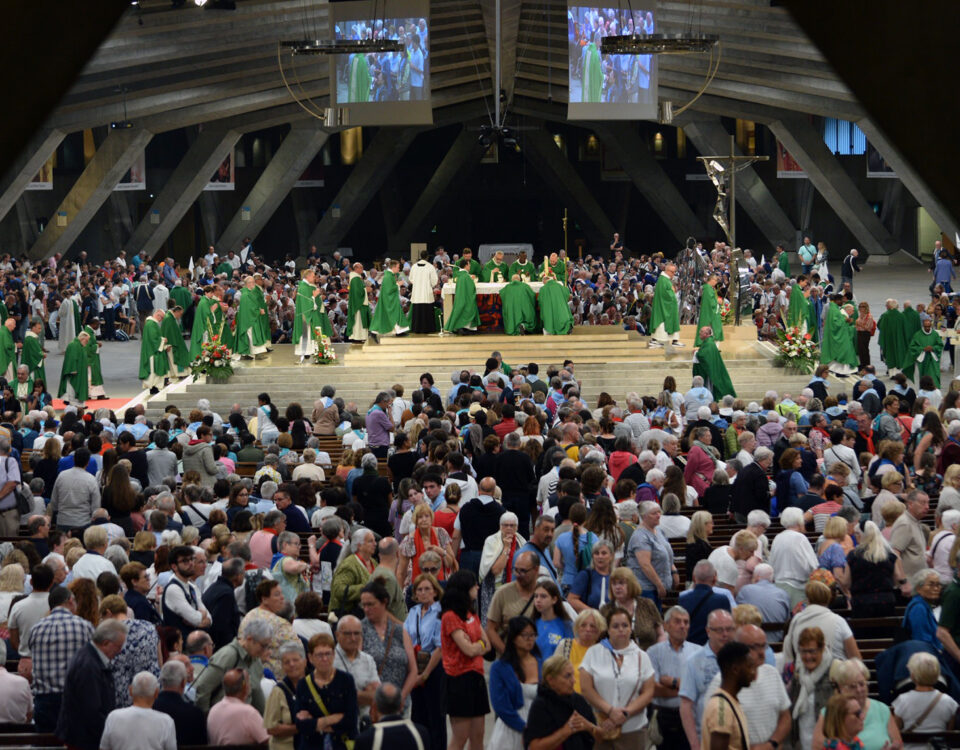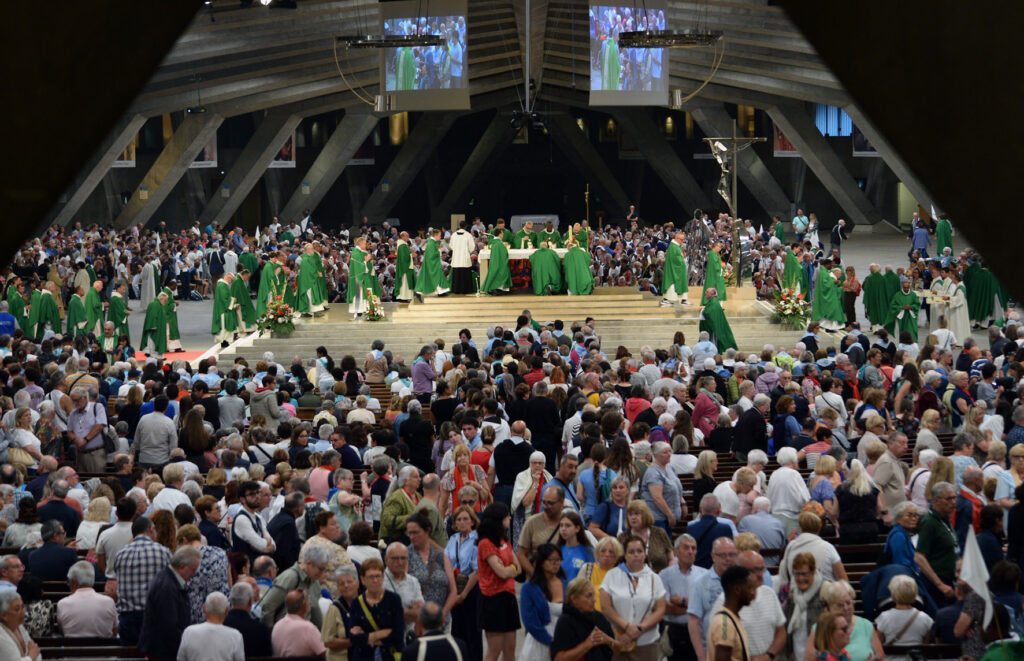

Ascension Celebrated in Solemnity at Cathedral
May 18, 2026
Marriage Celebration Mass – 13 June 2026
May 19, 2026
As we celebrate our fifty years as the diocese of East Anglia, let us remember the great places and events that mark the living Faith of places and people here in East Anglia. This month Dr Richard Charles Maguire (University of East Anglia, Norwich), turns in celebration, to the Cathedral Church of St John the Baptist, specifically focusing on its marvellous Victorian Gothic Revival architecture which makes the building one of the iconic buildings in this fine city. This focus should help all who use or visit the cathedral to understand the building even more.
In 1976, with the foundation of the Diocese of East Anglia, what had been the Parish Church of St John the Baptist, Norwich, became the new diocesan cathedral. Prior to the Protestant Reformation in England, which began in 1534, Norwich was blessed with over 50 Catholic churches, including a magnificent Norman Catholic cathedral. These churches were at the core of a rich and vibrant Catholic symbolic and sacramental world that defined medieval Norwich’s religious, economic, social, and cultural life.
After the Protestant Reformation, which was imposed ‘top-down’ by the government on a reluctant population, everything changed. Suddenly, and then for centuries, the city had no Catholic church in which the faithful could worship. The Holy Sacrifice of the Mass ceased to be celebrated, and the traditions of Catholicism in Norwich were largely forgotten, other than in a few houses, such as Oxburgh, where brave families kept the faith alive.
It was only in the late eighteenth century that Catholic worship was allowed to return to the city, in a small way. Finally, in 1829, England’s Catholics were freed from all the legal restrictions that had pressed upon them since the sixteenth century. In 1850, the Catholic hierarchy returned, and England witnessed a surge of Catholic church construction.
By this date, the dominant architectural style in England was Victorian Gothic, of which St John’s is a fine example. The medieval Gothic style, originating in France, had dominated the architecture of Europe in the Middle Ages. Gothic churches used innovations in engineering to create gorgeous visual landscapes that lifted the souls of worshippers towards the heavens. Their exquisite beauty meant that these Gothic churches offered a uniquely fitting place to worship God.
Medieval Gothic was a singular architectural style designed to lift souls towards our Creator in a fashion that has been increasingly difficult to replicate since the advent of modernity. The stunning stained-glass windows of Gothic churches bathed the interior with the light of heaven, suffusing worshippers with the Truth. Gothic architecture was, and remains, an unparalleled rendition of theology in stone and glass, enhancing and deepening Christian belief and worship through transcendental beauty.
Unfortunately, the Gothic style went out of fashion after the 1600s, but from the second half of the eighteenth century it became the inspiration for a new movement, the Victorian Gothic Revival. Men such as the architect Augustus Welby Northmore Pugin (1812–1852) argued that returning to the Gothic style in church building would revitalise worship and faith. Such beautiful architecture would, they proposed, help to rejuvenate the sense of the sacred in a society desperately in need of Christ. They argued that, since God is the source of beauty, the exquisiteness of Gothic architecture would help people to move closer to God. The result of this movement was that the nineteenth and early twentieth centuries saw the restoration of many medieval churches that had been damaged in the upheavals following the Protestant Reformation, and the construction of scores of stunning new churches across England, both Anglican and Catholic.
St John’s was part of this movement. Built between 1882 and 1910, the church was designed by George Gilbert Scott Junior (1839–97) and completed by his brother John Oldrid Scott (1841–1913). While its Gothic Revival style was never in doubt, the man who paid for the entire church, Henry Fitzalan-Howard, the fifteenth Duke of Norfolk (1847–1917), told Scott that he wanted the church to take its specific inspiration from the thirteenth century, since Norwich had no medieval churches from that period. The Duke also wanted a huge church, far too large for the needs of the parish at that time. His foresight ensured that, when a cathedral was needed in 1976, a church of sufficient size and grandeur already existed.
With the Duke’s instruction in mind, George Gilbert Scott Junior and his brother used all the essential Gothic elements to create a glorious place of worship. They did not simply copy medieval Gothic, however. Instead, they reinterpreted its elements and produced one of the finest Gothic Revival churches in England.
Outside, the impression is one of solidity and permanence. The building is long, but the design emphasises its height. St John’s climbs high above the visitor, reaching towards heaven, with a massive central tower that soars powerfully upwards. Outside, the flying buttresses provide engineering stability while artistically emphasising the church’s strength and beauty. The entire building seems to be designed to stand until the Day of Judgement. The stonework outside is heavily ornamented, with superb carvings. The terminal façades (the fronts) to each arm have strong, triple lancet windows, with huge buttresses and pinnacles (which look like small spires on either side) flanking the gable.
Every centimetre of the church is used to add to its elegance. Throughout the building, stunning Frosterley marble has been used to increase the beauty of the entrances, internal piers, and arches. Inside St John’s, the Scott brothers used all the elements of the Gothic style, incorporating pointed arches, complex ribbed roof vaulting, large stained-glass windows, and ornate stonework. When you are next in the cathedral, look for dragons carved on the piers in the nave (dragons, of course, signify the evil that has been defeated by Christ on the Cross), the angels on the walls of the chapels singing the Gloria, and the stunning stone leaf foliage, representing the glory of Creation. Look up at the ceilings and notice that the roof bosses along the nave depict the entire story of salvation, from the Garden of Eden to the Second Coming of Christ, while those above the chancel depict the Passion, Resurrection, and Ascension of Our Lord.
The stained-glass windows, mostly created by Hardman & Co., who at the time were making England’s best stained glass, are some of the finest Victorian windows in the world. As the new book on the windows, The Way of Beauty, to be published this year to coincide with the diocesan anniversary, explains, the windows are superb examples of art that also explain Christian theology and Catholic history. These windows are one of the artistic gems of the entire region of East Anglia.
Unfortunately, the Duke of Norfolk died in 1917 and, without his financial support, the internal furnishing of the church was not completed as planned. In the excesses following the Second Vatican Council (1962–1965), considerable damage was caused by the removal of internal furnishings that had been installed over the previous sixty years. The church lost the high altar and altar rails, whose brass gates had been designed by John Oldrid Scott, along with an excellent pulpit. Despite these losses, the cathedral retains the magnificent golden chandeliers above the chancel, the superb metal gates of the baptistery, the ornate heating grilles in the floors, and the lovely metalwork on the main doors.
St John’s is not just a building; it is one vast prayer that has been given a physical presence in stone and glass. The Victorian Gothic Revival followed the lead of the medieval Gothic and focused on worshipping the Holy and Undivided Trinity, rather than focusing on humanity, as tends to happen in modernism. The movement was a deliberate attempt to use the medieval Gothic style to evangelise secular culture. In a contemporary world desperately in need of Christ, the choice of the Duke of Norfolk and the Scott brothers to use the Gothic Revival style remains relevant. The diocese has a wonderfully beautiful cathedral. Everyone in the diocese should try to visit this place of prayer and beauty as part of our Jubilee celebrations. Beauty gives praise to God, who is the True, the Good, and the Beautiful. When you are next in St John’s, please join in that praise.