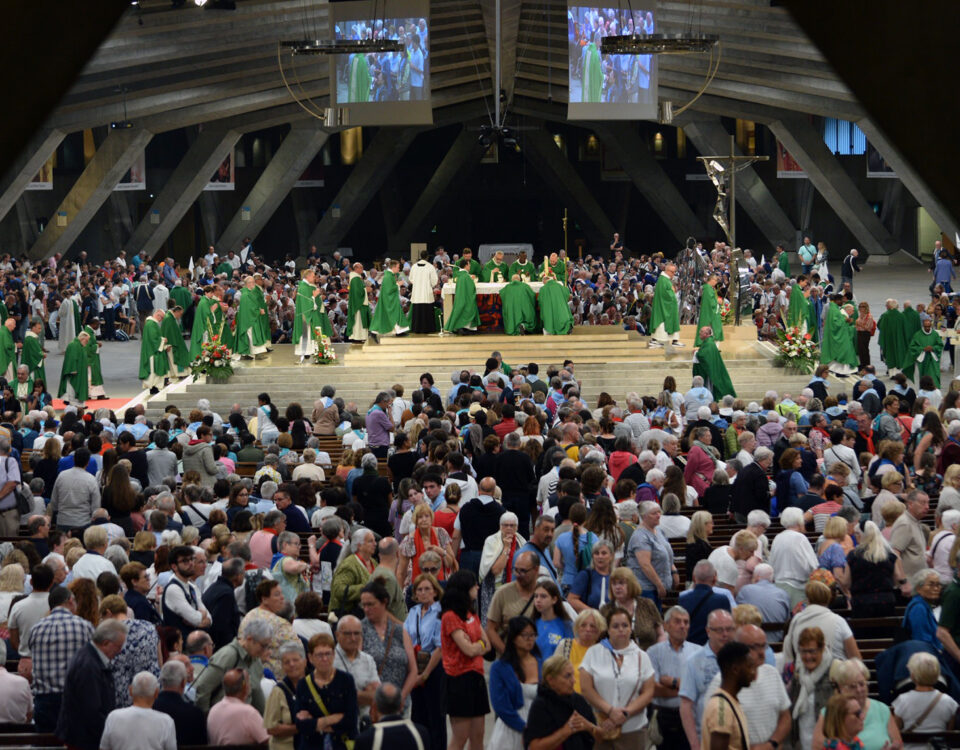

Mass & Anointing of the Sick at St Cecilia’s, Dersingham
June 21, 2026
Diocese Prepares for Golden Jubilee Celebration
June 22, 2026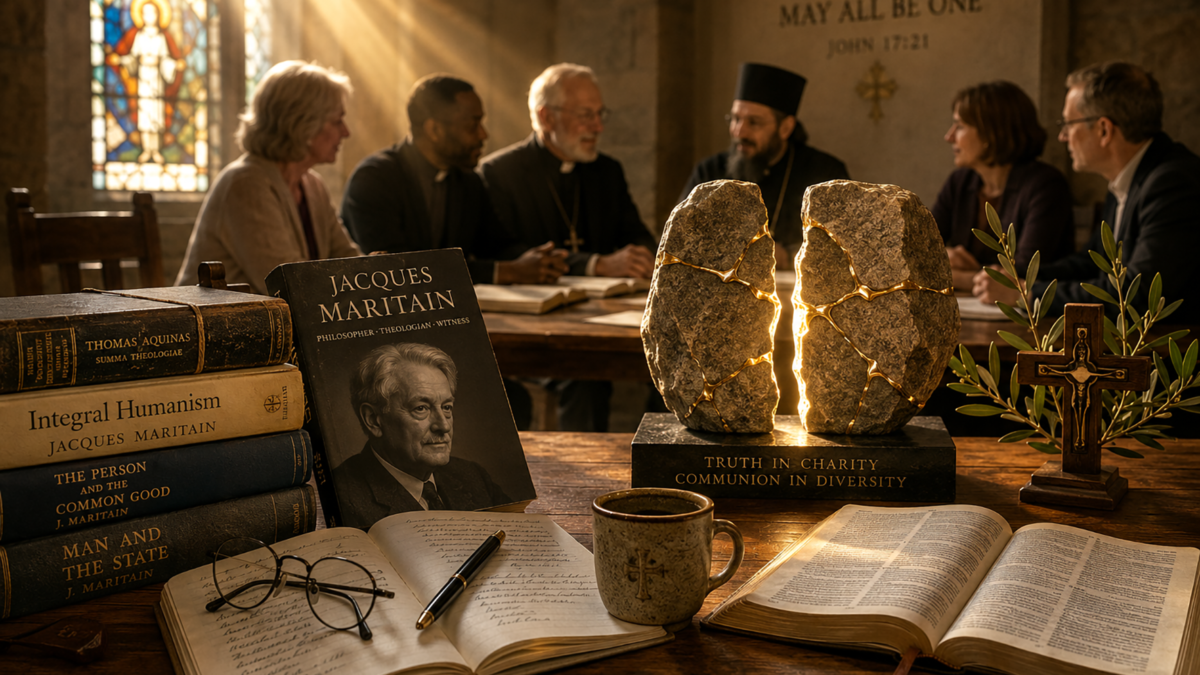
Unity Corner is a regular feature on Christian unity by Dr Ian Watson, County Ecumenical Officer for Norfolk and Waveney. In this reflection, he explores how the philosophy of Jacques Maritain demonstrates that Christian unity is essential not only for the Church itself, but also for strengthening its witness to human dignity, reconciliation and the common good in contemporary society.
In justifying the pursuit of Christian unity, it is understandable to turn towards theology, ecclesiology, or the history of Church division. While these are essential, some of the most illuminating contributions to ecumenical thinking come indirectly through philosophers and social thinkers who help us understand why unity matters for the life of the world. One of the most interesting figures to me is Jacques Maritain.
Maritain (1882–1973) was one of the most influential Catholic thinkers of the twentieth century. Born in Paris, he studied at the Sorbonne before converting to Catholicism alongside his wife, Raïssa. Deeply influenced by Thomas Aquinas, he became a leading figure in modern Thomist philosophy and helped shape contemporary Catholic Social Teaching. His major works include Integral Humanism (1936), The Person and the Common Good (1947), and Man and the State (1951).
He is best known for several key ideas. First, every human being possesses dignity not because of usefulness, productivity, or social status, but because of who they are before God. Second, he rejected both radical individualism and oppressive collectivism, arguing instead that society should pursue the common good – the moral, social, and spiritual conditions that allow people and communities to flourish. Third, he developed the idea of Integral Humanism, a vision of society in which culture, politics, economics, and public life remain open to transcendence and moral truth.
Although Maritain was not an ecumenical theologian, his work offers much for Christians seeking a deeper account of unity. For me, he helps explain why Christian disunity weakens the Church’s moral and spiritual witness within contemporary culture.
At the heart of his philosophy lies the conviction that every person is created by God and called towards truth and communion. Human beings are never merely economic units, political instruments, or members of competing tribes. Society must therefore be ordered towards the flourishing of the whole person – materially and spiritually.
This conviction shaped much twentieth-century Catholic social reflection and influenced the development of modern human rights language after the Second World War. Maritain famously observed that people could agree on practical human rights principles “provided no one asks us why”. His point was not that truth is unimportant, but that meaningful cooperation remains possible despite profound philosophical disagreement.
That insight has obvious relevance for ecumenism. Christians from different traditions do not yet share complete theological agreement; nevertheless, we can still recognise in one another a genuine commitment to Christ, Scripture, prayer, service, and the dignity of the human person. It is in this way that Maritain encourages us to build constructively upon what we share, without pretending that our differences no longer matter.
At the same time, nonetheless, he warns against reducing Christian unity to vague goodwill or mere social cooperation. Human flourishing, for him, was rooted in objective truth, natural law, and humanity’s relationship with God. Ecumenism must therefore involve more than friendliness or shared activism. It remains inseparable from the Christian search for truth and the Church’s deeper spiritual vocation.
This is where Maritain remains ecumenically valuable today. He reminds us that Christian unity is not simply about improving relations between churches, but about strengthening the credibility of Christian witness within society itself. We all know that modern culture often seeks to separate moral concern from transcendent truth while, at the same time, Christians (if not careful) can become absorbed by denominational defensiveness and internal disputes. Maritain challenges both these tendencies by calling Christians towards a shared public witness grounded in truth, reason, and the common good.
Behind this conviction is his rich understanding of the common good. For Maritain, the concept means far more than collective prosperity or social stability. It refers to the conditions that allow people and communities to flourish spiritually and in justice, virtue, solidarity, and peace. Society should nurture what is genuinely good for human beings, not merely what is economically efficient or politically convenient.
This understanding of the common good is fully reflected in Pope Leo XIV’s first encyclical, Magnifica Humanitas. For me, however, it also prompts a further question. If the common good depends upon relationships characterised by solidarity, cooperation, and mutual responsibility, what might this mean for Christians themselves? After all, the Church is called not simply to proclaim reconciliation but also to embody it.
I believe that this is where Maritain’s thought takes on an important ecumenical dimension. Churches acting separately often achieve much that is good and worthwhile. Nevertheless, a divided Christian witness inevitably weakens our ability to serve the common good together. In other words, our proclamation becomes less persuasive when it is accompanied by visible separation.
In modern society, increasingly shaped by loneliness, distrust, fragmentation, and ideological hostility, the Church has an opportunity (even a divine obligation) to model a different way of living. When Christians remain visibly divided, however, we risk reflecting the very divisions we seek to heal rather than offering a credible sign of reconciliation, solidarity, and hope.
If this is correct, then ecumenism is not merely an internal Church concern. Christian unity reaches beyond ecclesiastical structures into the heart of the Church’s vocation within society. In this claim, I find myself returning repeatedly to what should be an obvious truth; namely, that a more visibly united Christianity is far better placed to defend the vulnerable, promote peace, uphold human dignity, and offer a coherent moral witness in an increasingly conflicted world.
This conviction resonates strongly with both Catholic Social Teaching and the vision encouraged by the Second Vatican Council. For example, Gaudium et Spes speaks of the Church’s solidarity with the “joys and hopes, griefs and anxieties” of humanity. Dignitatis Humanae affirms the dignity of conscience and religious freedom. Lumen Gentium presents the Church as a sign and instrument of unity for the whole human race, while Unitatis Redintegratio calls Christians to overcome division so that the Church’s witness may become more credible before the world.
It is unsurprising that many of the Council’s central concerns echo themes found throughout Maritain’s work. His friendship with Pope Paul VI is well known, and the esteem in which he was held was demonstrated on the Council’s closing day when Paul VI entrusted him with receiving the Message to Men of Thought and Science on behalf of the world’s intellectuals. The gesture symbolised Maritain’s lifelong commitment to showing that faith and reason, conviction and dialogue, belong together.
Some readers may note that Maritain later expressed concerns about developments surrounding Vatican II in The Peasant of the Garonne (1967). From my perspective, however, his criticism was not directed against ecumenism or the Council itself. Rather, he feared that Christians might become so eager to accommodate secular culture that they would lose confidence in the transcendent truths at the heart of the Gospel.
No matter your stance, I feel this warning is still applicable today, particularly when it comes to ecumenism. In refusing both the temptation to retreat from the modern world and the temptation simply to mirror it, Maritain reminds us that Christian unity cannot be sustained by theological vagueness or cultural fashion. Sure, it requires openness, cooperation, and friendship, but these must always be grounded in truth, worship, and living faith. Unity is most credible when churches together embody a way of life in which conviction is joined to humility, truth to charity, and faith to service.
This vision can be seen throughout post-Vatican II Catholic teaching. For example, Pope John Paul II linked human dignity, freedom, and Christian truth, including in Ut Unum Sint. Pope Francis emphasised fraternity and social friendship in Fratelli Tutti. More recently, Pope Leo XIV has repeatedly called for peace, dialogue, friendship, and reconciliation in a divided world. Each reflects the conviction that Christian faith is not merely a private possession, but a gift intended for the flourishing of society as a whole.
In the end, Christian unity matters because the Gospel matters. A divided Church struggles to speak convincingly about reconciliation within a fractured culture. A more visibly united Church, however, offers a stronger sign of the dignity, hope, and communion to which humanity is called in Christ.
As Maritain himself wrote: “The human person possesses rights because of the very fact that it is a person, a whole, master of itself and of its acts, and which consequently is not merely a means to an end, but an end, an end which must be treated as such”. For Christians, that dignity finds its fullest meaning in the Gospel. Bearing witness to that truth is a task that belongs not to one denomination alone, but to all who confess Jesus Christ as Lord.